Prop Firm Trading Strategy What Works Best and Why for Consistent Funded Challenge Success
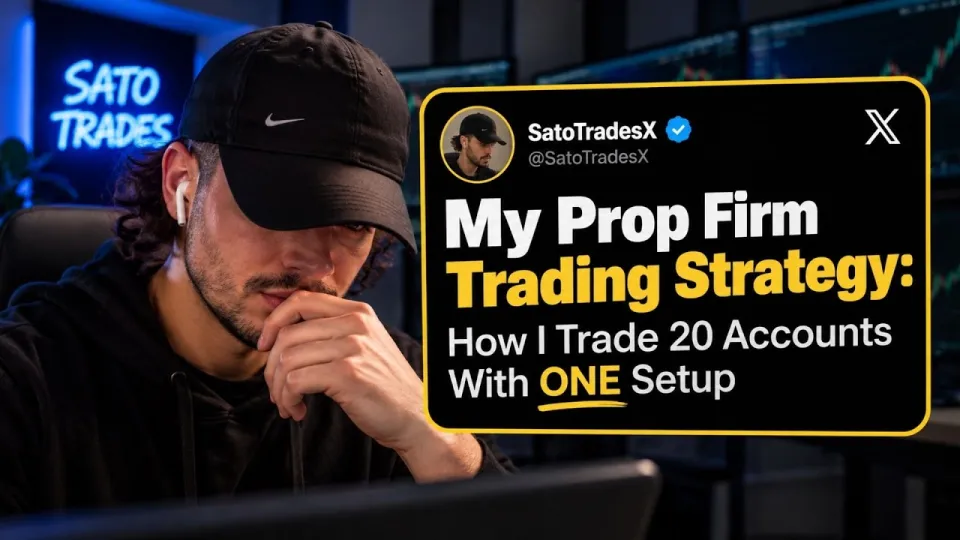
Video: Prop Firm Trading Strategy: How to Pass a Funded Challenge in 2026
Passing a prop firm trading challenge requires a well-defined prop firm trading strategy that emphasizes mechanical execution, risk management, and consistent setups. The best approach involves trading futures like ES (E-mini S&P 500) and NQ (E-mini Nasdaq) on the 1-minute chart, using predetermined daily and intraday levels to identify high-probability entries. For traders aiming to succeed in 2026, this strategy offers a path to reliable payouts and scaling opportunities through multiple funded accounts. To get started with daily ES & NQ levels and detailed tutorials, visit Sato VIP.
Understanding the Prop Firm Trading Strategy
A prop firm trading strategy designed for passing funded challenges focuses on mechanical rules rather than discretionary decisions. This means using a fixed system based on price levels, market structure, and order flow that can be repeated consistently.
Key components include:
- Daily and Intraday Levels: Mark major support and resistance levels for ES and NQ futures on the TradingView platform. These levels guide potential long and short entries.
- Confluence Zones: Trade entries occur where multiple levels align, increasing the probability of a successful trade.
- Market Structure Awareness: Avoid trading during unfavorable market conditions, such as when price action breaks key levels without confirmation or when volatility is too low.
By following these rules, traders reduce emotional bias and increase repeatable success rates in evaluation phases.
Using the 1-Minute Chart for Precise Entries
The 1-minute futures trading chart allows traders to pinpoint exact entry and exit points based on micro price action around key levels.
Steps to implement:
- Identify the daily ES & NQ levels before the market opens.
- Mark these levels clearly in TradingView, grouping and hiding unnecessary lines for clarity.
- Watch for price reactions at these levels on the 1-minute chart.
- Use limit orders to enter trades at optimal prices, setting stop losses and take profits immediately.
This short timeframe trading demands discipline but provides opportunities for multiple small, consistent gains essential for passing prop firm challenges.
Risk Management Rules to Protect Your Funded Account
Risk management is critical when trading prop firm accounts to avoid blowing the funded balance.
Key rules include:
- Limit risk per trade to a small percentage of the account (e.g., 1% or less).
- Use fixed stop losses and never move them further away during the trade.
- Set take profits based on predefined risk-reward ratios.
- Avoid overtrading; stick to your mechanical system and daily setups.
Following these rules ensures capital preservation, a top priority during evaluation and beyond.
Handling Price Action and Market Structure
Effective prop firm trading requires understanding when not to trade. Market structure analysis helps identify these moments.
Avoid trading when:
- Price breaks through high timeframe levels without retesting.
- Volatility is abnormally low or erratic.
- The market is trending strongly against your planned entry.
Patience is essential. Waiting for clear setups aligned with your mechanical system increases your chances of meeting prop firm challenge targets.
Scaling Prop Firm Trading Through Multiple Accounts
Once you consistently pass evaluations and earn payouts, scaling your funded trading is possible by managing multiple accounts.
Approach:
- Use trade copiers and platforms like Tradovate to handle multiple accounts simultaneously.
- Maintain the same mechanical strategy across all accounts.
- Monitor risk per account independently to avoid correlated drawdowns.
Scaling enhances payout potential and builds professional-level trading income streams.
Typical Questions and Challenges in Prop Firm Trading
Many traders struggle with knowing how to mark levels properly, manage risk, and maintain discipline during challenges. Common issues include:
- Difficulty reading and grouping levels on TradingView
- Emotional responses leading to abandoning stop losses
- Confusion on when to trade or stand aside based on market structure
The mechanical system approach with clear rules and tools helps overcome these challenges, as confirmed by trader feedback praising the clarity and effectiveness of this method.
Useful Links
- Daily ES & NQ Levels, Bias, and Tutorials: https://satotrades.com/vip
- Guide to Best Futures Prop Firms: https://satotrades.com/guides/best-futures-prop-firms
- Free Discord with Daily Levels and Proof: https://discord.gg/Yt5PuQjXRp
- Trade Copier for Managing Multiple Accounts: https://portal.tradecopia.com/signup?via=SATO
Итог
A successful prop firm trading strategy for passing funded challenges combines mechanical setups on the 1-minute chart, disciplined risk management, and understanding market structure. Following daily ES and NQ levels with fixed orders and stop losses is essential for consistent payouts. Scaling across multiple accounts can multiply earnings while maintaining controlled risk. This comprehensive method is detailed by the Sato Trades channel, which offers ongoing support and education for traders seeking professional results. For detailed daily levels and mentorship, visit Sato VIP.
Key takeaways
- Focus on futures trading using 1-minute charts for precise entries
- Use a mechanical trading system with clear daily ES & NQ levels
- Set fixed limit orders, stop losses, and take profits before trading
- Manage risk strictly to protect your funded account
- Scale your trading across multiple prop firm accounts for growth
Questions & answers
What is the best timeframe to trade when using a prop firm strategy?
The 1-minute chart is recommended for precise entries and exits in futures trading, allowing traders to react to price action around key levels accurately.
How important is risk management in passing prop firm challenges?
Risk management is critical; traders should risk a small percentage per trade, use fixed stop losses, and avoid moving stops to protect the funded account and ensure consistent results.
Can traders manage multiple prop firm accounts simultaneously?
Yes, using trade copier software and platforms like Tradovate, traders can manage multiple accounts with the same strategy to scale their trading and increase payouts.
How do I know when not to trade during a prop firm evaluation?
Avoid trading during unfavorable market conditions such as strong trends against your bias, low volatility, or when price breaks key levels without confirmation, to reduce losing trades and protect capital.
Source: Prop Firm Trading Strategy: How to Pass a Funded Challenge in 2026 · Markdown version